Karpathy Releases 'Autoresearch': AI Agents That Run 126 ML Experiments Overnight
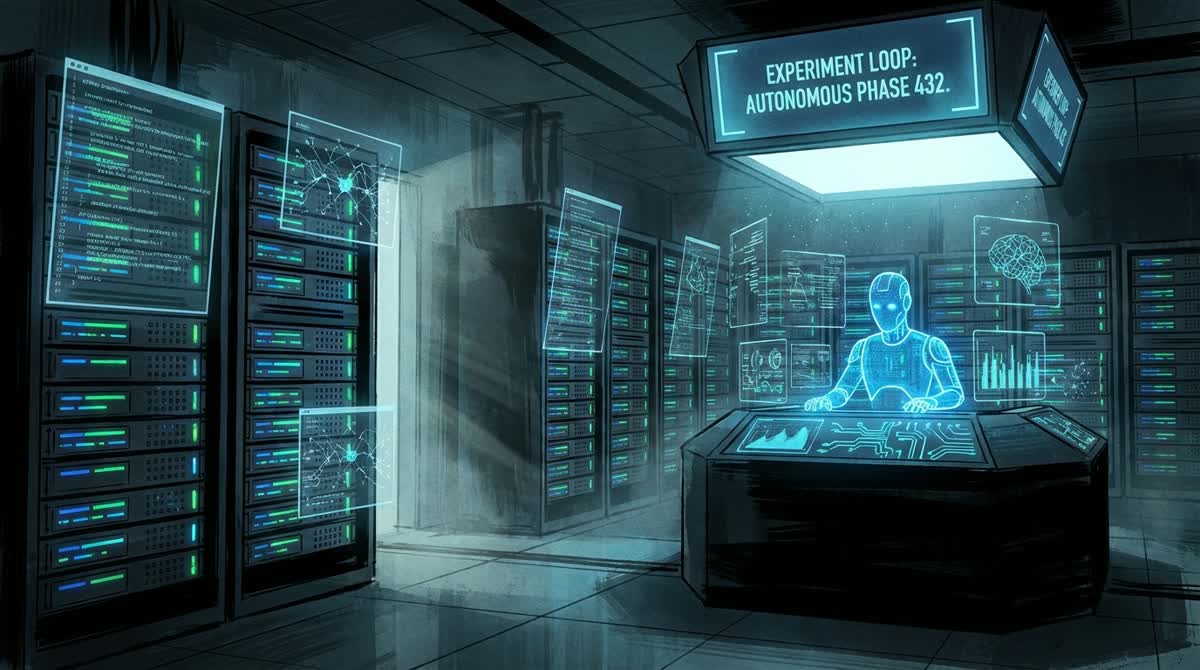
Andrej Karpathy, former Tesla AI director and OpenAI co-founder, dropped a deceptively simple open-source tool on March 8 that's generating serious attention in the ML community: autoresearch, a single-file, ~630-line Python script that turns AI agents into autonomous research machines.
How It Works
The framework sets up a tight loop between a human researcher and an AI agent. The human writes high-level research instructions in Markdown. The agent reads those instructions, modifies training code — tweaking architectures, learning rates, or hyperparameters — and runs exactly a 5-minute GPU training session. If the validation loss (measured in bits-per-byte) improves, the change gets committed. If not, it reverts and tries again.
In Karpathy's own overnight run, the agent completed 126 experiments and reduced validation loss from 0.9979 to 0.9697 BPB — entirely without human intervention.
Two Days, 700 Changes, 11% Gain
After letting the agent run for two full days on a "depth=12" model, it processed approximately 700 autonomous changes and identified around 20 additive improvements. The result: the "Time to GPT-2" benchmark dropped from 2.02 hours to 1.80 hours — an 11% efficiency gain on a codebase Karpathy said was already well-tuned.
"Seeing the agent do this entire workflow end-to-end and all by itself... is wild," Karpathy wrote on X.
Real-World Adoption
Shortly after release, Shopify CEO Tobi Lütke adapted the framework for an internal project and reported a 19% improvement in validation scores. The tool is MIT-licensed and optimized for single NVIDIA GPUs, making it accessible to individual researchers without cluster access.
The project signals a new paradigm: AI-accelerated AI research, running at machine speed, overnight.