China's 15th Five-Year Plan Targets 90% AI Integration, Humanoid Robots, and Flying Cars by 2030
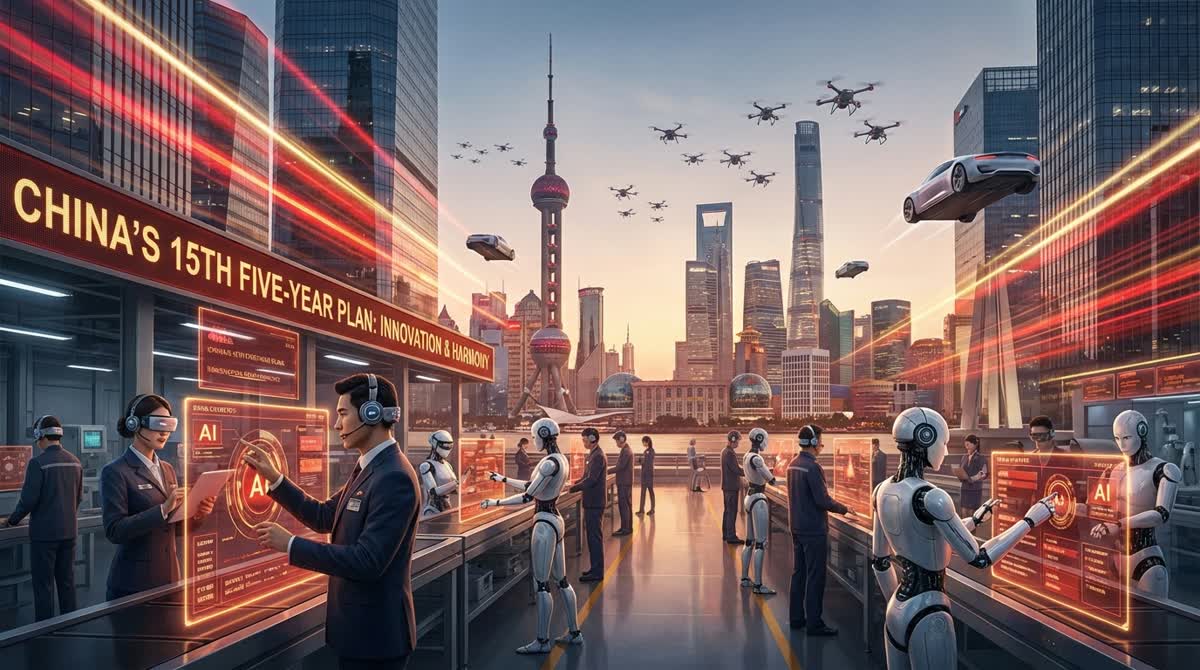
China has released its 15th Five-Year Plan, a sweeping blueprint to position the country as the global leader in artificial intelligence and advanced technology by 2030. The plan sets an explicit target of integrating AI into 90% of China's economy within five years — a more aggressive goal than any previous national tech strategy.
Ten Priority Areas
The plan identifies ten sectors for concentrated investment, including:
- Humanoid robots — accelerating mass deployment in factories and homes
- AI workplace systems — automating routine white-collar tasks
- Brain-computer interfaces — using AI to translate neural signals into commands
- Low-altitude equipment — flying cars and large-scale drone delivery networks
- Future industries — nuclear fusion, quantum computing, biomanufacturing, and 6G
Billions of dollars in state incentives and tax deductions are earmarked to support entrepreneurs and researchers across all ten areas.
Open Source as a Strategic Weapon
A notable pillar of the plan is a commitment to keeping most Chinese AI models open source. Brookings Institution fellow Kyle Chan noted that this directly contrasts with the US approach, where most leading models are proprietary and require paid access. Beijing views open-source AI as a way to spread adoption faster — domestically and globally — while reducing dependence on American platforms.
Self-Reliance Over Supply Chain Risk
The plan also sets self-reliance as a core requirement, aiming to cut China's dependence on US chips, software, and infrastructure. Analysts view the 15th Plan as China's most technologically ambitious since it launched the "Made in China 2025" initiative a decade ago.