USDC Flips USDT in Transaction Volume for First Time Since 2019
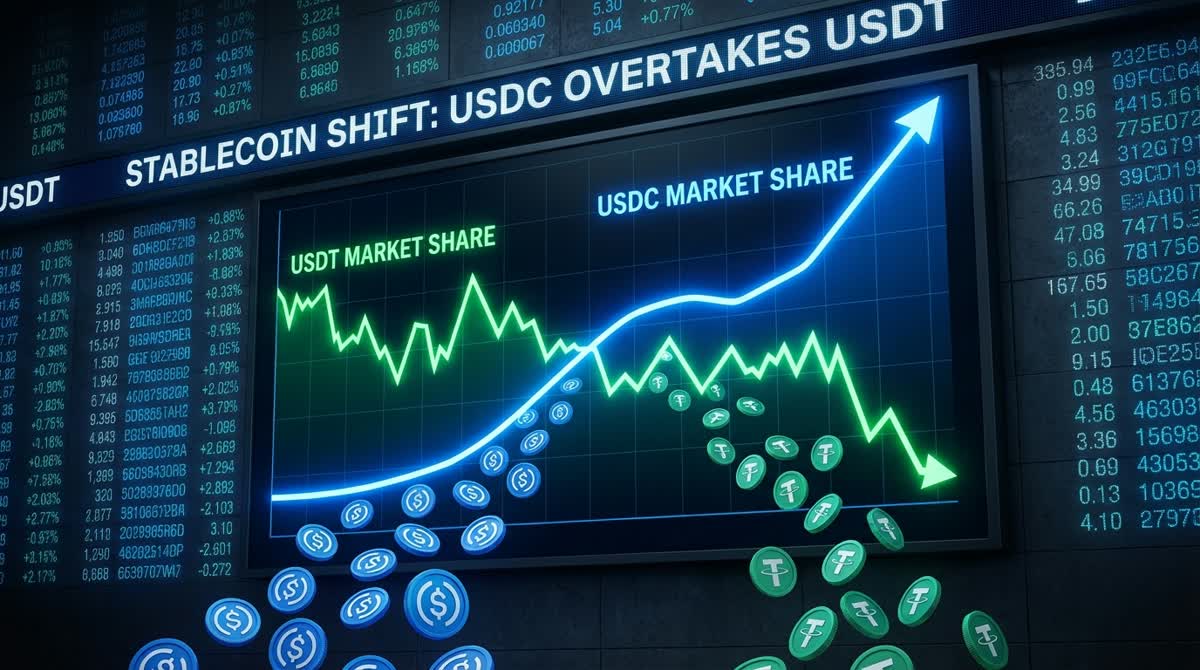
Circle's USDC has overtaken Tether's USDT in adjusted transaction volume for the first time since 2019, a reversal that signals a structural shift in how stablecoins are actually being used — not just held.
The Numbers
So far in 2026, USDC has recorded roughly $2.2 trillion in adjusted transaction volume, compared with $1.3 trillion for USDT — giving USDC about a 64% share. From 2019 through 2025, USDT consistently led and USDC averaged around 30% of adjusted volumes. That dominance has now flipped.
Market cap still favors Tether: USDT sits at $143 billion, USDC at $78 billion. But analysts increasingly argue that real economic activity — not supply — will determine the long-term winner.
What's Driving It
Mizuho analysts cited two key use cases pushing USDC volume higher: Polymarket (prediction markets) and agentic commerce — AI agents transacting autonomously on behalf of users. Both trends are accelerating on Base L2 and across the broader Ethereum ecosystem, where USDC is the dominant settlement layer.
The shift also reflects USDC's advantage in regulated markets. As stablecoin legislation advances through Congress and U.S. state legislatures, Circle's compliance posture is drawing more institutional volume.
Broader Outlook
Standard Chartered projects the total stablecoin market cap could reach $2 trillion by end of 2028. Mizuho raised its price target on Circle (CRCL) to $120 from $100, maintaining a neutral rating. Circle shares are up roughly 95% from February lows.
The USDC flip doesn't mean Tether is losing ground on supply — but it does suggest that on-chain economic activity is increasingly routing through USDC rails.