Nvidia's DLSS 5 Is the 'GPT Moment for Graphics' — Neural Rendering Comes to Gaming
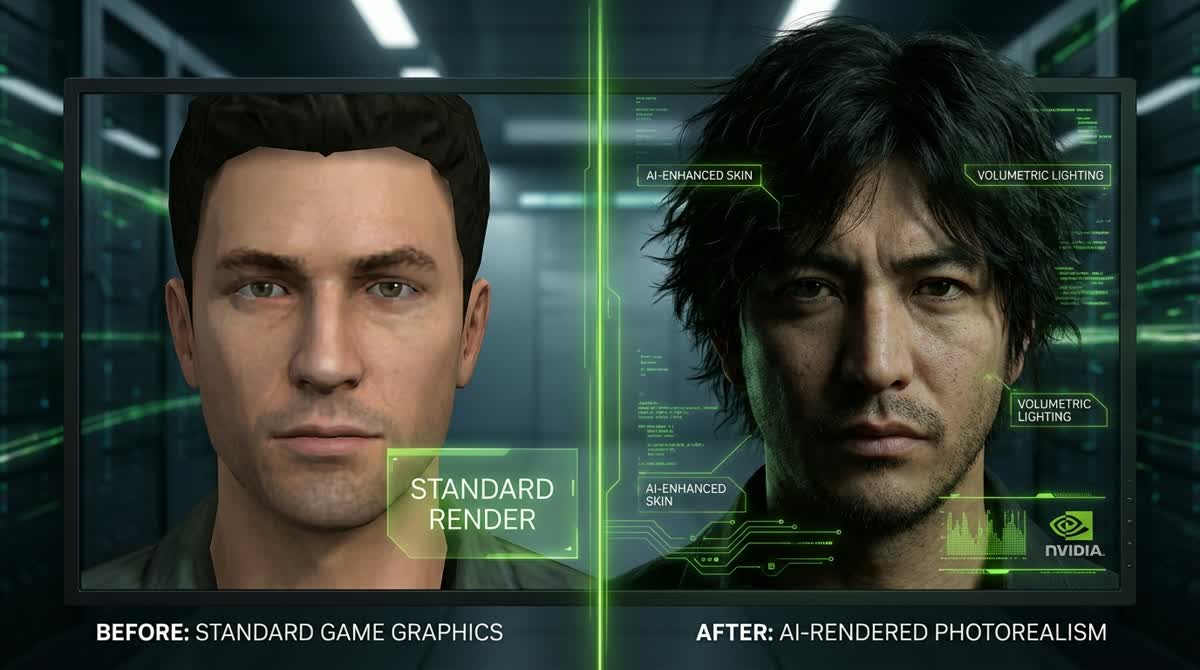
Nvidia dropped a second major announcement at GTC 2026 on Monday: DLSS 5, a real-time neural rendering system the company says is the most significant graphics breakthrough since ray tracing debuted in 2018.
What DLSS 5 Actually Does
Previous DLSS versions were about performance — upscaling lower-resolution frames and generating fake frames in between real ones. DLSS 4.5, launched at CES 2026, already draws 23 out of every 24 pixels using AI.
DLSS 5 goes a step further. It takes a game's raw color output and motion vectors as input, then uses an AI model to regenerate the scene with photorealistic lighting and materials — the kind of rendering quality previously limited to offline Hollywood VFX pipelines that take minutes per frame.
The model understands complex scene semantics: hair, skin, fabric, environmental lighting. It can handle subsurface scattering on skin and material sheen on cloth in real time at up to 4K resolution, without losing frame-to-frame consistency.
Jensen Huang called it "the GPT moment for graphics — blending handcrafted rendering with generative AI to deliver a dramatic leap in visual realism while preserving the control artists need."
Developer Support and Timeline
Game developers retain fine-grained control over intensity, color grading, and masking, so studios can maintain their art direction. Integration uses the same NVIDIA Streamline framework as earlier DLSS versions, making adoption relatively straightforward.
Publishers already confirmed for DLSS 5 support include Bethesda, CAPCOM, Tencent, Ubisoft, and Warner Bros. Games.
DLSS 5 arrives on GeForce hardware this fall.