Nvidia Debuts Groq 3 LPX at GTC 2026 — 35x Faster Inference, Built on $20B Deal
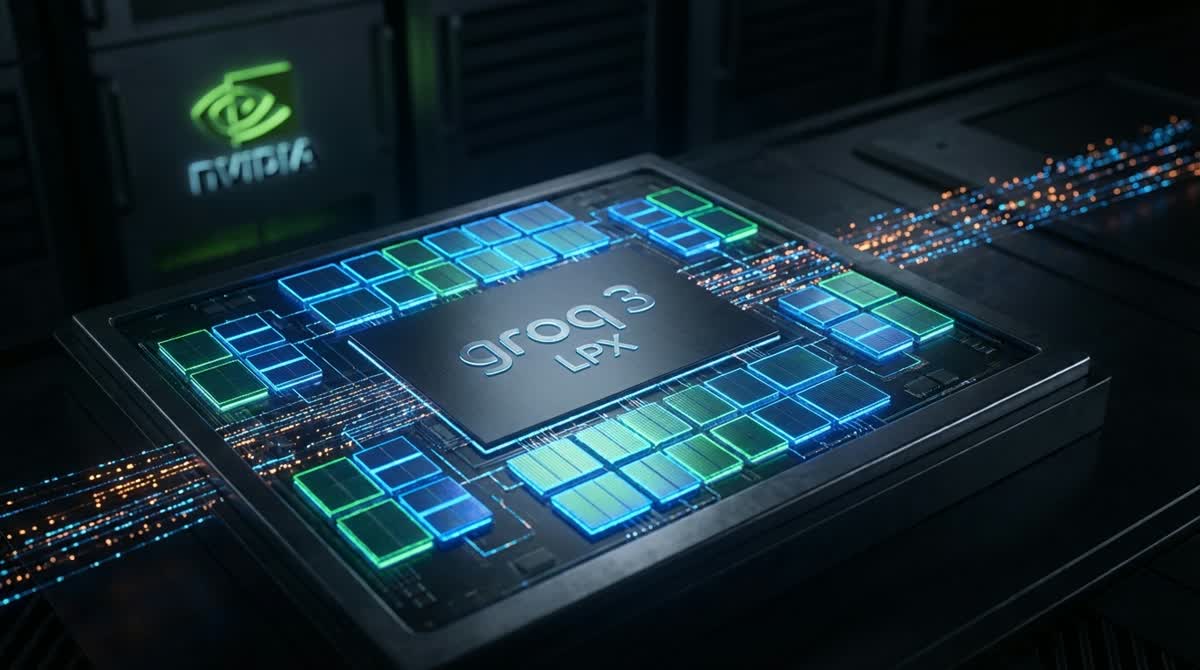
At GTC 2026 in San Jose on Monday, Nvidia CEO Jensen Huang announced the Nvidia Groq 3 LPX — the company's first chip purpose-built for AI inference. The announcement marks Nvidia's entry into a market it previously ceded to startups.
A Different Kind of Chip
Where the Vera Rubin GPU handles training and prefill with 288 GB of HBM4 memory and 50 petaFLOPS of FP4 compute, the Groq 3 LPX takes a radically different approach. Instead of HBM, it uses SRAM integrated directly onto the processor — a design Groq pioneered to eliminate off-chip memory round-trips. The result: 150 TB/s of memory bandwidth, seven times faster than Vera Rubin's 22 TB/s.
The tradeoff is capacity: only 500 MB of SRAM versus 288 GB of HBM. But for inference, that constraint barely matters — what counts is moving tokens fast, not holding the entire model.
Disaggregated Inference
At the system level, Nvidia is introducing disaggregated inference as a first-class architecture. Vera Rubin handles the prefill phase (processing the input prompt), while Groq 3 LPX handles the decode phase (generating output tokens). Jensen Huang described latency and throughput as "enemies of each other" — a problem this split architecture is designed to solve.
Nvidia says the combination delivers up to 35x faster inference versus GPUs alone, with up to 10x improvement in revenue per rack for cloud operators.
Origins and Shipment
The Groq 3 LPX traces back to the $20 billion licensing deal Nvidia struck with startup Groq in December 2025, which also brought Groq's top engineers in-house. Samsung manufactures the chip. Huang confirmed shipments in the second half of 2026.
Nvidia now projects $1 trillion in demand for its Blackwell and Rubin systems through 2027 — up from $500 billion projected just a year prior.