NVIDIA Open-Sources Physical AI Data Factory Blueprint at GTC 2026
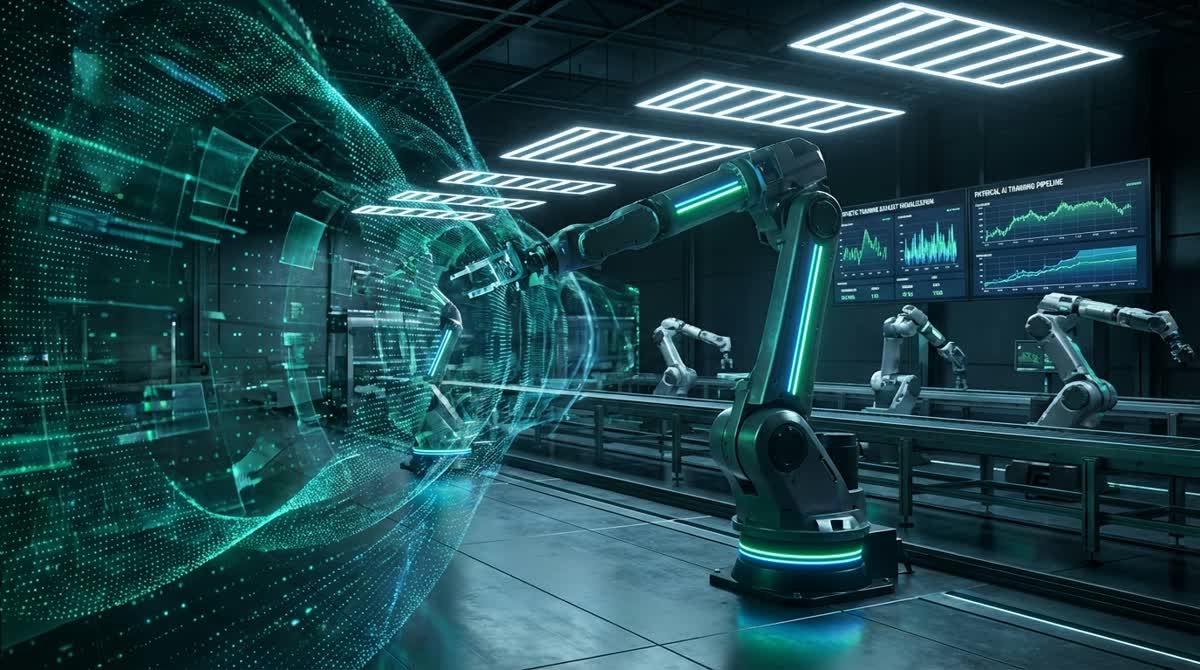
At GTC 2026, NVIDIA announced the Physical AI Data Factory Blueprint — an open reference architecture designed to eliminate the most stubborn bottleneck in physical AI development: the scarcity of high-quality training data.
The Core Problem
Physical AI systems — robots, autonomous vehicles, and vision agents — are notoriously data-hungry. Real-world data collection is slow, expensive, and often misses the rare edge cases that matter most. NVIDIA's blueprint tackles this by automating the full pipeline from raw inputs to model-ready training sets using its Cosmos open world foundation models.
The workflow has three stages: Cosmos Curator processes and annotates large-scale real and synthetic datasets; Cosmos Transfer expands and diversifies that data to capture rare long-tail scenarios; and Cosmos Evaluator (now open source on GitHub) automatically scores and filters outputs against physical accuracy criteria.
AI Agents Run the Whole Thing
The more striking development is in orchestration. NVIDIA's OSMO framework — which manages these workflows across compute environments — now integrates directly with AI coding agents including Claude Code, OpenAI Codex, and Cursor. In practice, this means coding agents can autonomously manage resources, resolve pipeline bottlenecks, and accelerate model delivery without human intervention.
"In this new era, compute is data," said Rev Lebaredian, VP of Omniverse and simulation technologies at NVIDIA.
Who's Using It
Microsoft Azure and Nebius are integrating the blueprint into their cloud infrastructure. On the physical AI side, Skild AI is using it to build general-purpose robot foundation models, and Uber is applying it to autonomous vehicle development alongside its DRIVE AV partnership announced at the same keynote. Other adopters include FieldAI, Hexagon Robotics, Linker Vision, Milestone Systems, RoboForce, and Teradyne Robotics.
NVIDIA itself is using the blueprint to train Alpamayo, described as the world's first open reasoning-based vision-language-action (VLA) model for autonomous driving.