Humanoid Robot Digit Is Now Working 8-Hour Factory Shifts in South Carolina
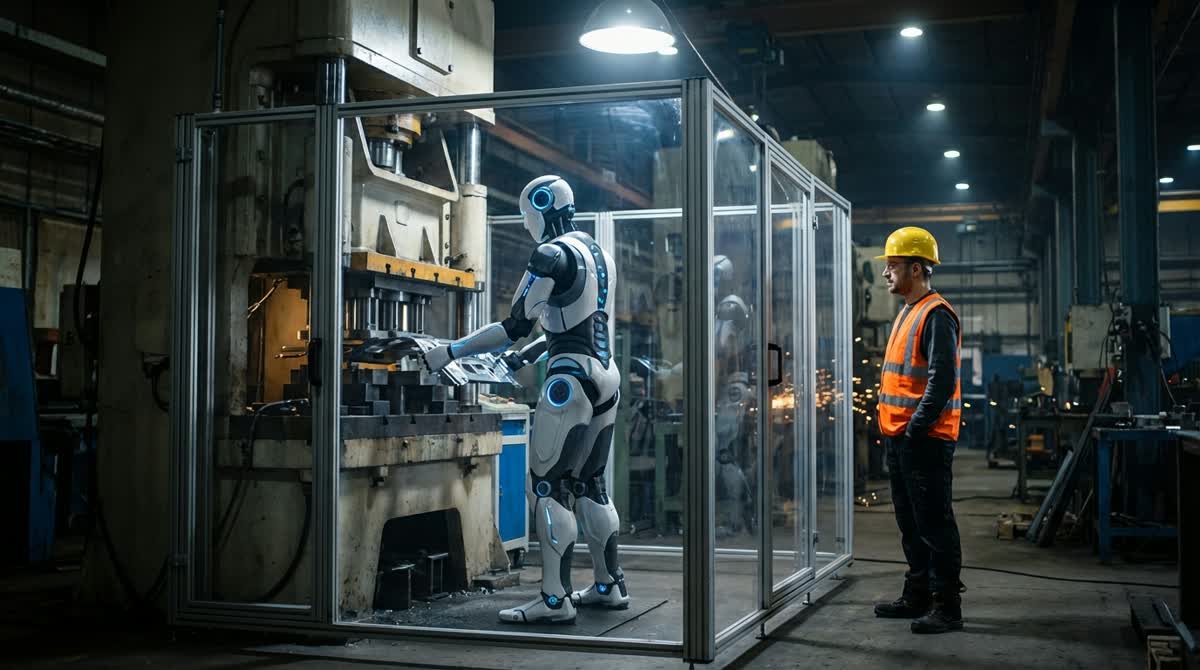
Agility Robotics' Digit is no longer a demo. The bipedal humanoid is now pulling full eight-hour shifts at Schaeffler's auto parts plant in Cheraw, South Carolina, according to new Wall Street Journal reporting. The robot handles 25-pound bearing component baskets from stamping presses — dexterous, repetitive work that until recently was considered too complex for general-purpose machines.
Still in a Cage — for Now
Digit currently operates inside a plexiglass enclosure. The barrier isn't a vote of no confidence in the robot; it's an OSHA machine-guarding compliance requirement. Digit can't yet detect and respond to humans in its immediate environment, so it has to be separated. Agility says that capability is expected to arrive by the end of 2026, at which point Digit could work side-by-side with human colleagues on the line.
The Economics
The numbers are what make this story genuinely significant. Over its lifetime, Digit currently costs customers $10 to $25 per hour depending on the deployment model — a wide range that reflects the early-market pricing structure. Agility co-founder Damion Shelton has stated the target is $2 to $3 per hour. Entry-level positions at the Cheraw plant — which is not unionized — start at $20 per hour.
The math isn't subtle: if humanoid robots reach $2-3/hour at scale, cost parity with human workers becomes irrelevant.
Momentum Is Building
Schaeffler holds a minority stake in Agility and has committed to deploying humanoids across all 100 of its global manufacturing plants by 2030. In February, Toyota Motor Manufacturing Canada signed a commercial Robots-as-a-Service agreement for seven Digit units at its Woodstock, Ontario plant building RAV4 SUVs — after a year-long pilot.
The "robot babysitter" job — a human contractor paid to observe and supervise Digit — is the most telling detail. It's a transitional role, and everyone involved knows it.