NVIDIA and T-Mobile Want to Turn Every Cell Tower into an AI Brain
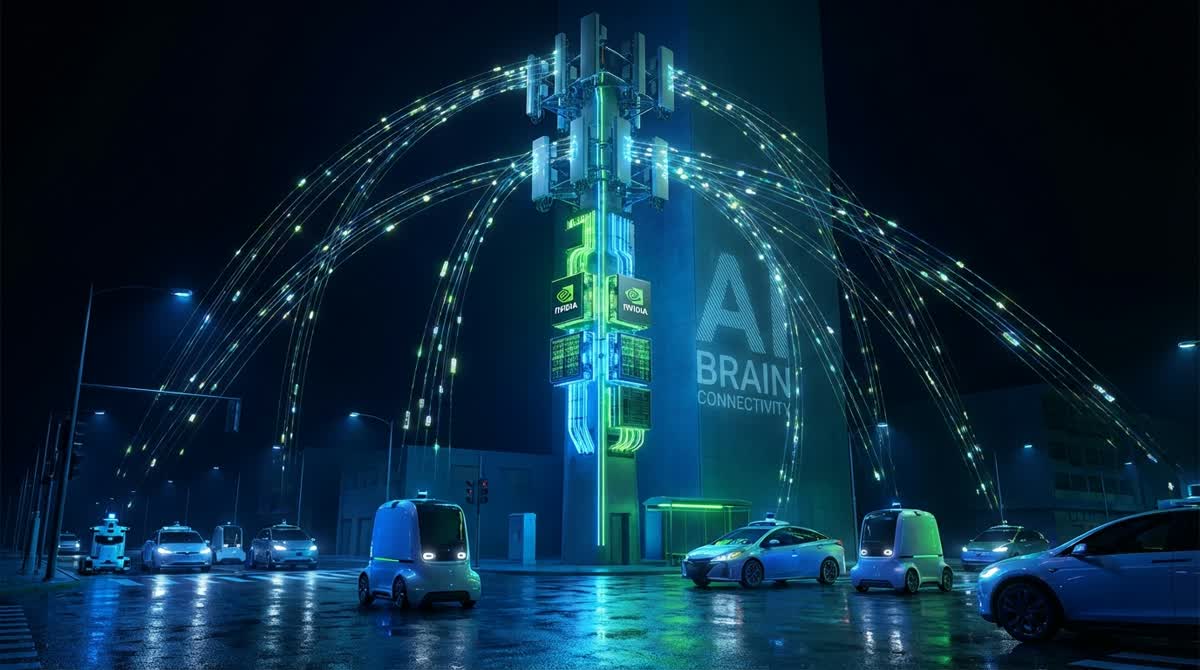
Jensen Huang's GTC 2026 keynote included a vision that went beyond data centers: every cell tower becomes a robotics radio tower. NVIDIA, T-Mobile, and Nokia announced a joint initiative to build AI-RAN (AI Radio Access Network) infrastructure, turning telecom base stations into distributed edge AI compute nodes.
What Is AI-RAN?
Traditional cell towers relay wireless signals. The new model layers in GPU compute — specifically NVIDIA's RTX PRO 6000 Blackwell Server Edition hardware — so towers can run AI inference locally instead of routing everything to distant cloud data centers. T-Mobile is already piloting the setup.
The pitch is latency and locality. Physical AI applications — robots navigating warehouses, autonomous vehicles reading live traffic, smart city systems — need inference responses in milliseconds. Cloud round-trips add too much lag. Edge AI at the cell tower cuts that gap.
Nokia's Role
Nokia provides the RAN hardware and software stack, while NVIDIA supplies the AI compute layer and developer tools. Together they're building a platform that lets third-party developers deploy physical AI apps over the distributed network — a kind of AI app store for real-world machines.
The Bigger Picture
Jensen framed telecom as one of several industries NVIDIA is physically embedding itself into — alongside automotive (NVIDIA DRIVE with Uber), manufacturing (ABB, KUKA, Universal Robots), and healthcare. The AI-RAN push reflects a broader bet: the next wave of AI isn't in the cloud, it's in the physical world, and the wireless network is the backbone connecting AI to machines.
T-Mobile's pilot represents the first large-scale test of whether that vision actually works in the field.