Tesla Launches Terafab to Build Its Own AI Chips
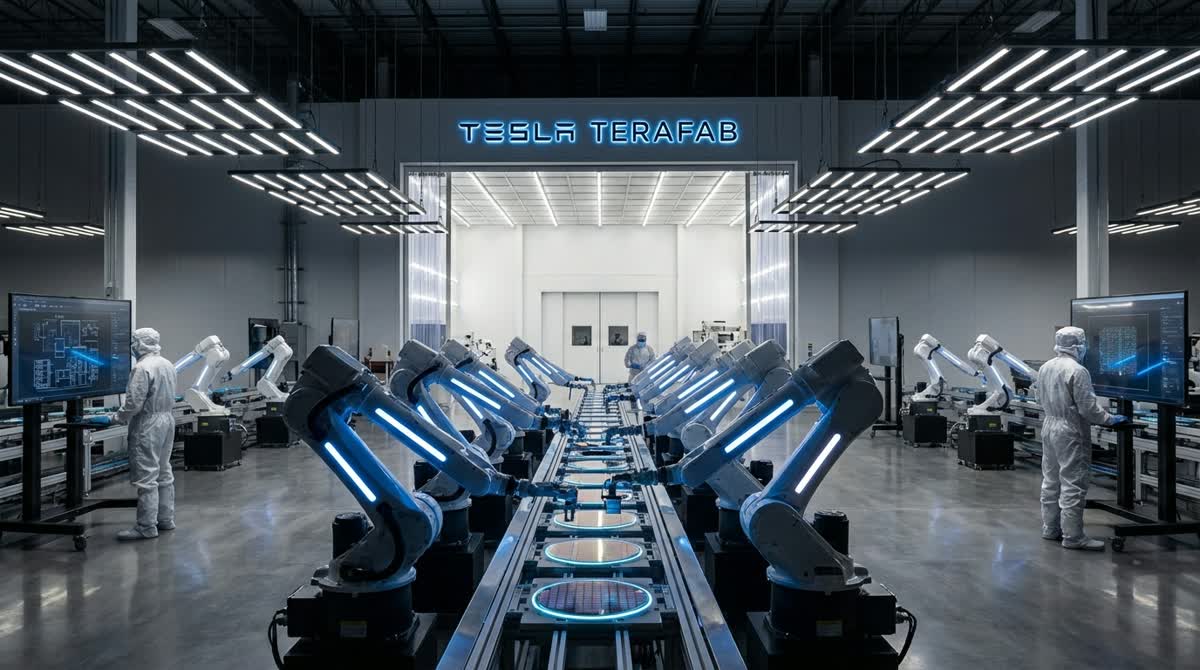
Tesla officially kicked off its Terafab project today, the start of the company's bid to manufacture its own AI chips on U.S. soil. CEO Elon Musk announced "Terafab Project launches in 7 days" on March 14; today is that day.
The initiative addresses what Musk has called an unavoidable supply ceiling. Even combining peak output from all current chip suppliers, Tesla won't have enough compute to scale Full Self-Driving, robotaxis, and Optimus humanoid robots on its planned timeline. "In order to remove the probable constraint in 3–4 years, we'll have to build a very big fab, domestically," Musk said. Tesla has allocated $20 billion in capex for 2026 toward robotics and AI chip infrastructure.
The AI5 and What Comes Next
Terafab is built around Tesla's AI5 chip, which the company claims delivers a 50x overall improvement over AI4 — including 10x more raw compute and 9x greater memory capacity. These figures are manufacturer-stated and have not been independently benchmarked.
The AI5 itself won't initially come from Terafab; it will be manufactured by TSMC in Arizona and Samsung in Texas. Terafab is a longer-term bet. Meanwhile, Musk has said the AI6 — the next chip generation — could reach tape-out by December 2026, slated for production at Samsung's Texas plant under a $16.5 billion, eight-year contract.
Geopolitical Hedge
Beyond compute capacity, Terafab is also a hedge against supply chain risk. Dependence on TSMC in Taiwan remains a vulnerability; an in-house fab would reduce exposure to any disruption in East Asian manufacturing.
Tesla has not disclosed a site, construction timeline, or first-production target. Analysts have called it potentially the most difficult engineering challenge Musk has taken on — harder, one said, than landing rockets.