Stripe's AI Minions Ship 1,300 Pull Requests Per Week — With Zero Human Code
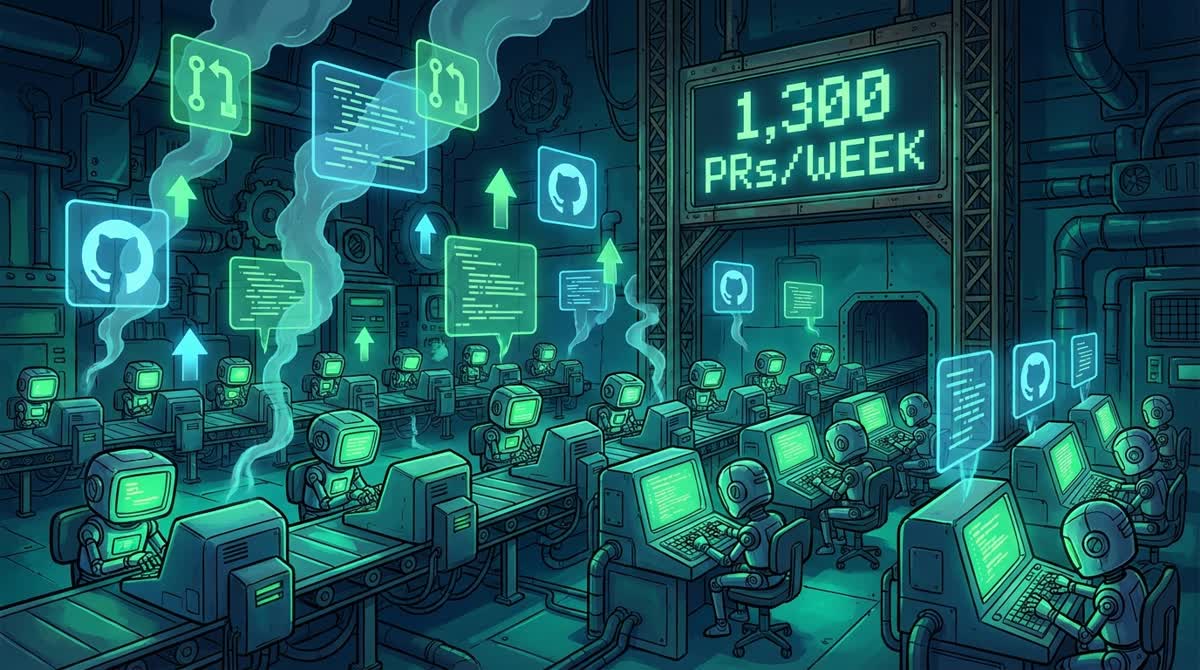
Stripe's internal autonomous coding agents are generating over 1,300 pull requests per week — with zero human-written code. Every PR is reviewed by a Stripe engineer, but the writing, testing, and documentation are handled entirely by machines. The system, called Minions, is one of the most concrete deployments of agentic AI at production scale.
From Slack to Production
Minions accept tasks from Slack threads, bug reports, or feature requests. A single instruction triggers the agent to plan, write code, produce tests, and open a pull request. Engineers review the output; they don't touch the code.
The system is built on a customized fork of Goose, Block's open-source coding agent, adapted to Stripe's internal LLM infrastructure and tooling.
Blueprint Architecture
Stripe's core architectural invention is the blueprint — a workflow defined in code that mixes deterministic steps with flexible LLM agent loops. Blueprints specify how a task is broken into subtasks and whether each step runs as fixed logic or is delegated to the model. This hybrid keeps Minions reliable on high-stakes code without fully trusting the model on critical operations.
Quality control comes from CI/CD pipelines, automated tests, and static analysis — all run before any human review.
The Stakes
The code Minions produce runs on infrastructure supporting over $1 trillion in annual payment volume. Stripe notes that Minions excel at well-scoped tasks: dependency upgrades, configuration changes, and minor refactoring — where correctness can be automatically validated. Output grew from 1,000 to 1,300 PRs per week, a 30% jump, with no slowdown reported.
Production-scale agentic coding is no longer a research demo.