Generalist AI's GEN-1 Hits 99% Success Rate, Claims First Commercially Viable Robot Foundation Model
Five months after proving scaling laws exist in robotics with GEN-0, Generalist AI has released GEN-1 - and the numbers tell the story. The new embodied foundation model hits 99% success rates on physical tasks where GEN-0 managed 64%, completes them roughly 3x faster than the previous state of the art, and needs just one hour of robot-specific data to adapt.
From Lab Demo to Factory Floor
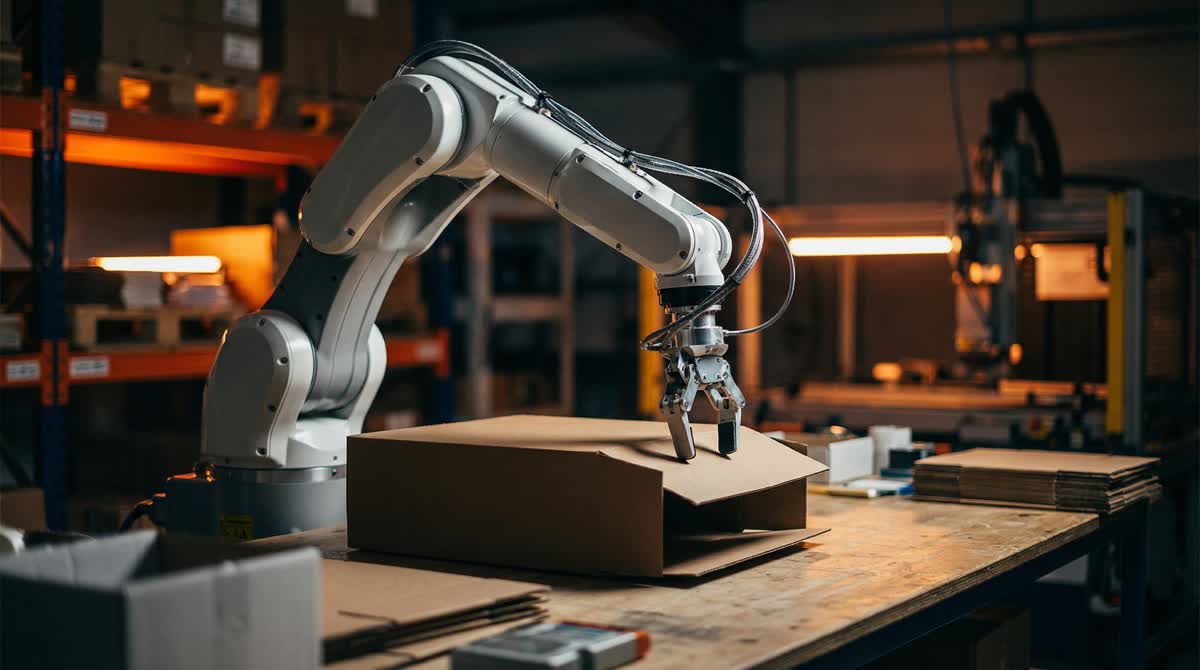
The company demonstrated GEN-1 folding boxes 200 times consecutively, servicing robot vacuums over 200 times, and packing blocks more than 1,800 times - all without human intervention. These aren't scripted industrial motions. GEN-1 operates in unstructured environments, reacting to variability in real time.
The model's most striking capability is what Generalist calls "intelligent improvisation." In one test, when a plush toy snagged while being stuffed into a bag, the robot autonomously used its other arm to shake the bag free. CEO Pete Florence compared the moment to GPT-3 writing a novel limerick - emergent behavior the model was never explicitly trained for.
Half a Million Hours of Human Data
GEN-1 is pretrained on over 500,000 hours of physical interaction data collected through low-cost wearable "data hands" worn by humans, up from 270,000 hours with GEN-0. No robot data is used during pretraining; the model encounters actual hardware only during that final hour of task-specific adaptation.
Generalist AI acknowledges GEN-1 doesn't solve all tasks, but positions it as the first general-purpose physical AI model crossing into commercial territory - a threshold competitors like Physical Intelligence are also racing to reach.