Scientists Crack Solar's 'Impossible' Barrier With 130% Energy Yield
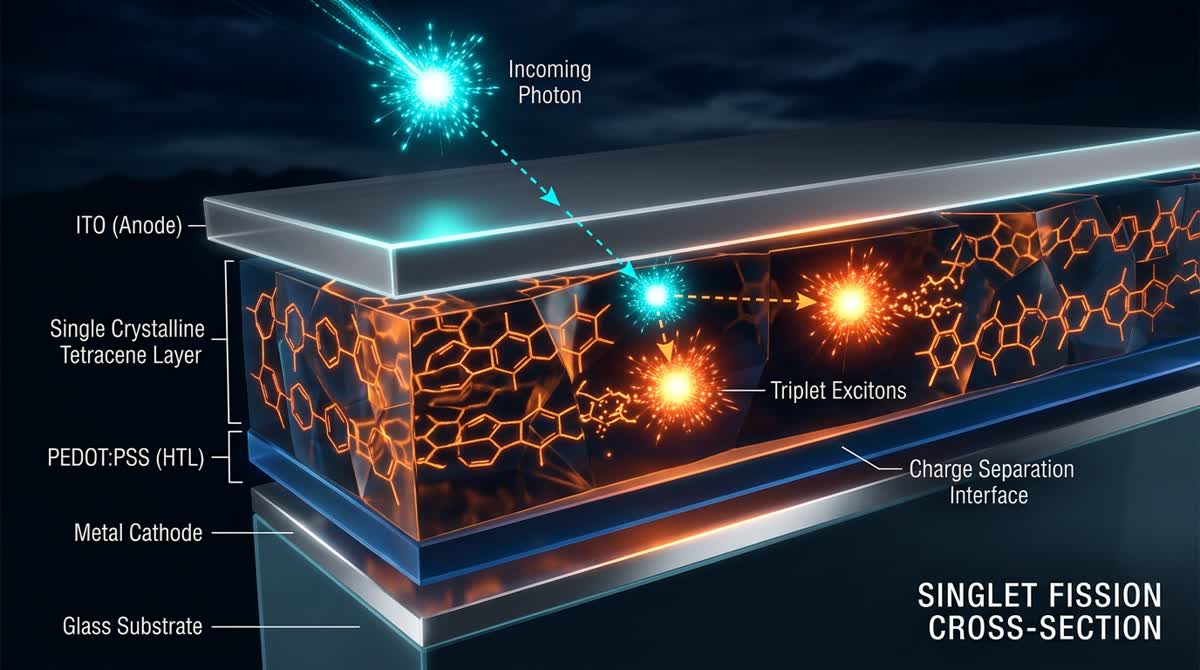
Researchers at Kyushu University in Japan and Johannes Gutenberg University Mainz in Germany have pushed solar energy conversion past a limit physicists long considered unbreakable. In a paper published March 25 in the Journal of the American Chemical Society, the team reported achieving a quantum yield of approximately 130% — meaning more energy carriers were produced than photons absorbed.
The Shockley-Queisser Ceiling
Traditional silicon solar cells are constrained by the Shockley-Queisser limit, a theoretical ceiling of roughly 33% efficiency for single-junction cells. The problem: low-energy infrared photons lack the punch to activate electrons, while high-energy blue photons waste their surplus energy as heat. The result is that most sunlight reaching a panel is simply lost.
Splitting One Photon Into Two
The team's approach exploits a process called singlet fission (SF), where a single high-energy photon generates two lower-energy excitons rather than one. Certain organic materials like tetracene can do this naturally, but a competing process — Förster resonance energy transfer (FRET) — typically siphons off the energy before it can be captured.
The breakthrough was a molybdenum-based "spin-flip" emitter that selectively intercepts the multiplied triplet excitons generated by SF while blocking FRET losses. By carefully tuning the energy levels between the tetracene and molybdenum materials in solution, the researchers achieved the 130% yield.
Caveats and Path Forward
The 130% measurement was made in a liquid solution, not from an operating solar panel — practical device integration remains a future step. The researchers note that this work demonstrates the principle rather than a deployable product. Still, Yoichi Sasaki, Associate Professor at Kyushu University, called it direct evidence that the Shockley-Queisser limit is not a hard ceiling for next-generation solar architectures.