World's First Quantum Battery Prototype Charges Wirelessly — and Gets Faster as It Grows
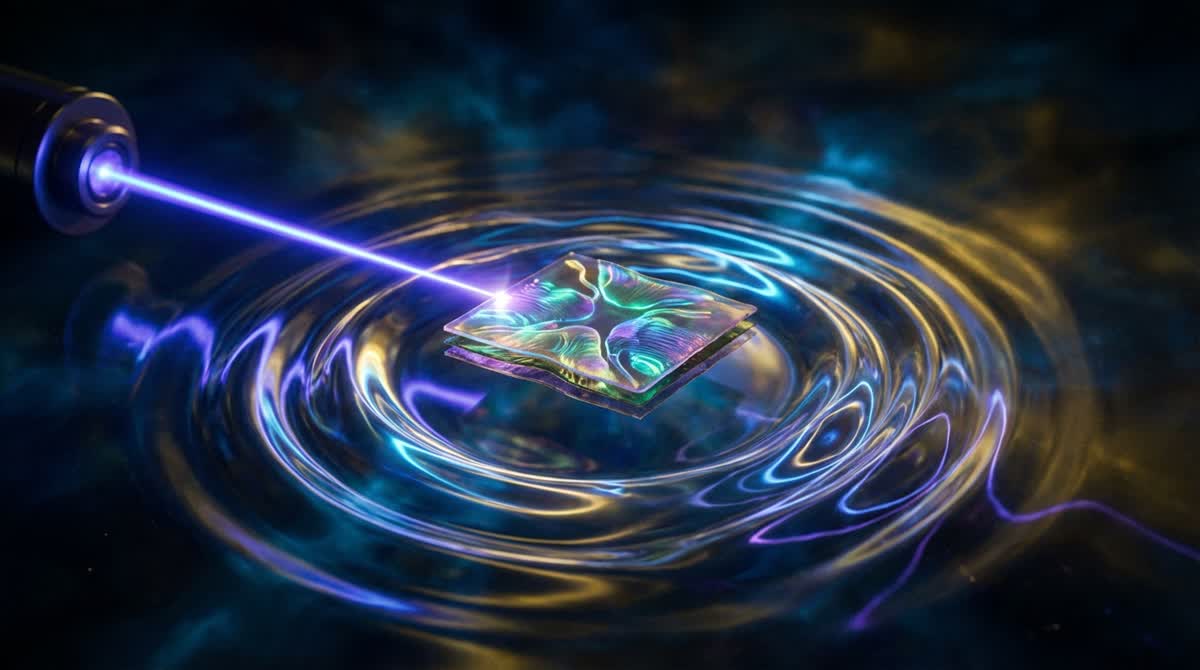
Researchers at CSIRO — Australia's national science agency — have demonstrated the world's first proof-of-concept quantum battery: a small device that can be charged, store energy, and discharge it, using the principles of quantum mechanics rather than chemical reactions.
The prototype is a thin, layered organic device that charges wirelessly using a laser beam. It was developed in collaboration with RMIT University and the University of Melbourne, with findings published in Light: Science & Applications.
Counterintuitive Physics
What makes the result notable is an unexpected property: the battery charges faster as it scales up. That behavior is the opposite of conventional batteries, where size doesn't improve charging speed.
"Our study found quantum batteries charge faster as they get larger, which is not how today's batteries work," said RMIT PhD candidate Daniel Tibben, a co-author on the paper.
The mechanism relies on super absorption — a collective quantum effect where many molecules absorb light simultaneously in a single rapid event. Lead author Dr. James Quach of CSIRO described the result as "rapid, scalable charging and energy storage at room temperature."
Not Ready for Electric Cars Yet
Experts are cautious about the timeline to practical use. Professor Andrew White of the University of Queensland, who was not involved in the research, called it "a really nice piece of work" but noted the batteries are "not going to turn up in any electric vehicles anytime soon." A nearer-term application may be powering quantum computers, where energy needs to be delivered coherently and at minimal cost.
The team's next focus is extending how long the battery can hold a charge — currently a critical limitation. Dr. Quach's long-term ambition: charging EVs faster than filling a gas tank, and delivering power to devices wirelessly over long distances.