Jensen Huang: Every Industrial Company Will Become a Robotics Company
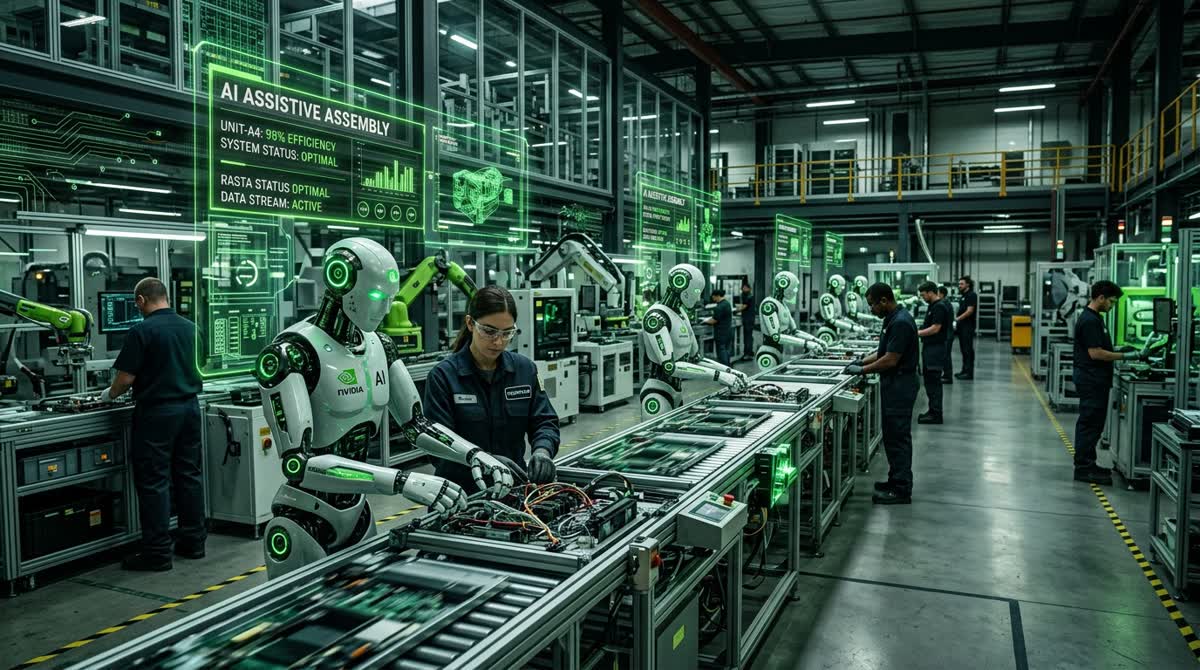
Speaking at NVIDIA's GPU Technology Conference last month, CEO Jensen Huang made a sweeping prediction: "Every industrial company will become a robotics company." The statement arrived during National Robotics Week 2026, as NVIDIA used the occasion to spotlight its growing stack of physical AI technologies.
From Chips to Robot Brains
NVIDIA, long associated with gaming graphics cards and AI datacenter chips, has spent several years repositioning itself as the backbone of AI-driven robotics. The company's Omniverse and Cosmos platforms let manufacturers build and test digital twins of factory floors before deploying physical systems. Its GR00T initiative develops foundation models specifically for robot intelligence.
"Physical AI has arrived," Huang said at GTC. "We're working with partners to implement our physical AI models so that we can deploy these robots into manufacturing lines."
Real-World Deployments
The prediction is already taking shape across industries. Skild AI is partnering with Foxconn to enhance production lines for electronics including iPhones and Nintendo consoles. Smaller manufacturers are adopting NVIDIA's Omniverse platform through services like Workr, which helps companies deploy robotic systems without deep programming expertise.
Robotics firms are using NVIDIA's software stack for digital twin construction, sensor processing, and robot training in simulated environments — cutting deployment cycles that previously took years.
The Bottleneck
Despite the momentum, a recent PwC survey found the biggest obstacle to AI-driven robotics adoption remains integration cost and workforce readiness. Manufacturers are projected to more than double their use of AI and automation by 2030, but bridging the gap between digital simulation and physical deployment remains the core engineering challenge.
National Robotics Week highlighted how quickly the gap is closing — and who stands to benefit most if Huang's prediction holds.