Google Adds Single-Host TPU Post-Training to MaxText
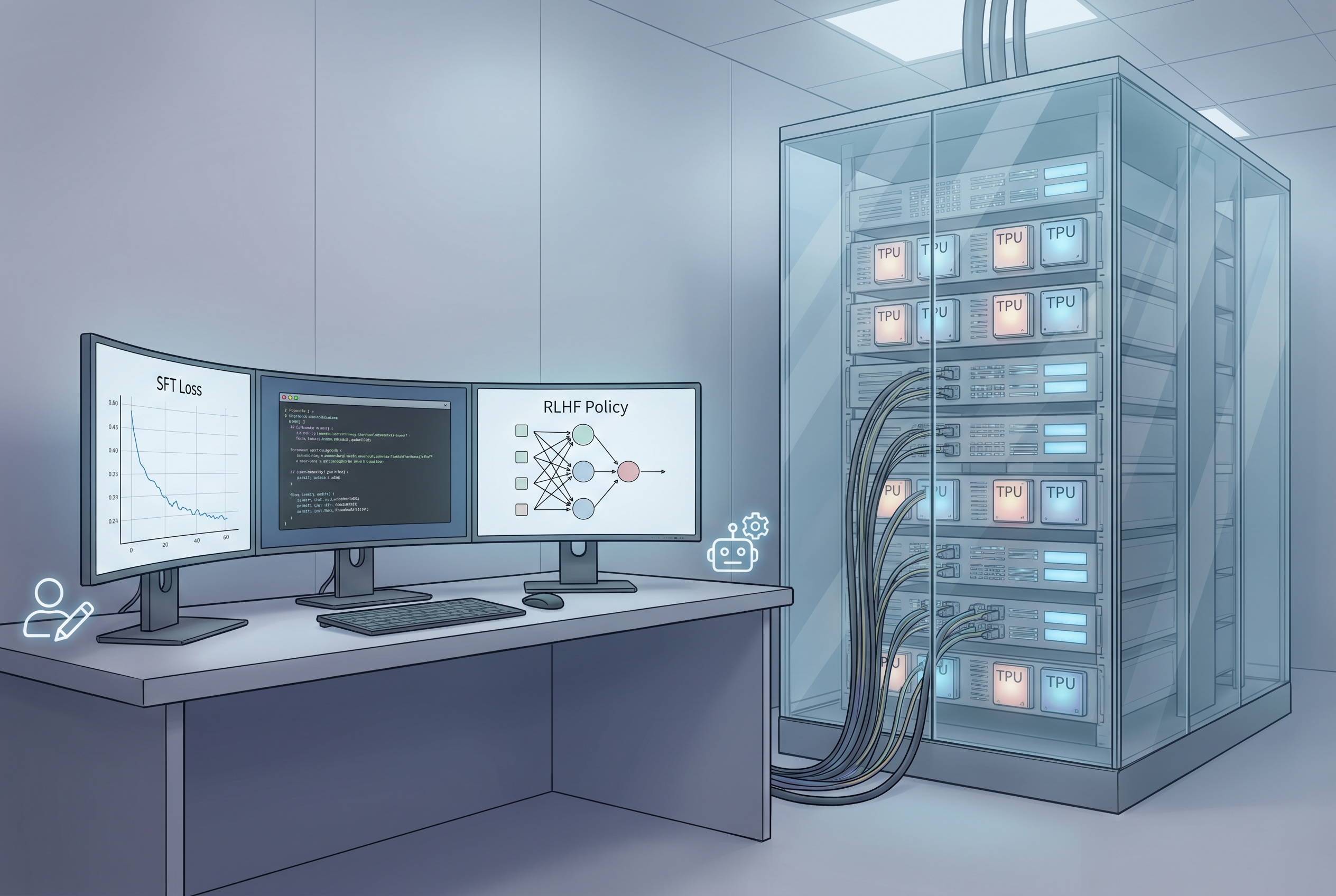
Google said MaxText, its open-source JAX training stack for TPUs and GPUs, now supports both supervised fine-tuning and reinforcement learning on single-host TPU configurations such as v5p-8 and v6e-8.
What changed
In a new developer blog post, Google said developers can fine-tune existing MaxText or Hugging Face checkpoints with SFT, or run RL workflows using GRPO and GSPO, without moving immediately to a larger multi-host cluster. The company points users to new documentation for both SFT and RL on single-host TPU VMs and says the feature set is available through the maxtext[tpu-post-train] installation path.
The published docs describe SFT jobs launched through maxtext.trainers.post_train.sft.train_sft and RL jobs through train_rl, with vLLM used for inference inside the RL loop. Google also says the workflows are built on Tunix, its JAX-based post-training library.
Why it matters
The conservative takeaway is not that small TPU hosts suddenly replace large training clusters. Instead, Google is making post-training easier to prototype and iterate on with lower infrastructure overhead. That matters for teams adapting open models to domain data, instruction tuning assistants, or testing reasoning-focused RL runs before scaling to multi-host jobs.
Google also said the same workflows are designed to transition to larger multi-host configurations later, which suggests single-host support is meant as an entry point rather than a separate product tier.