NVIDIA Brings Agent Skills To Physical AI Research At CVPR
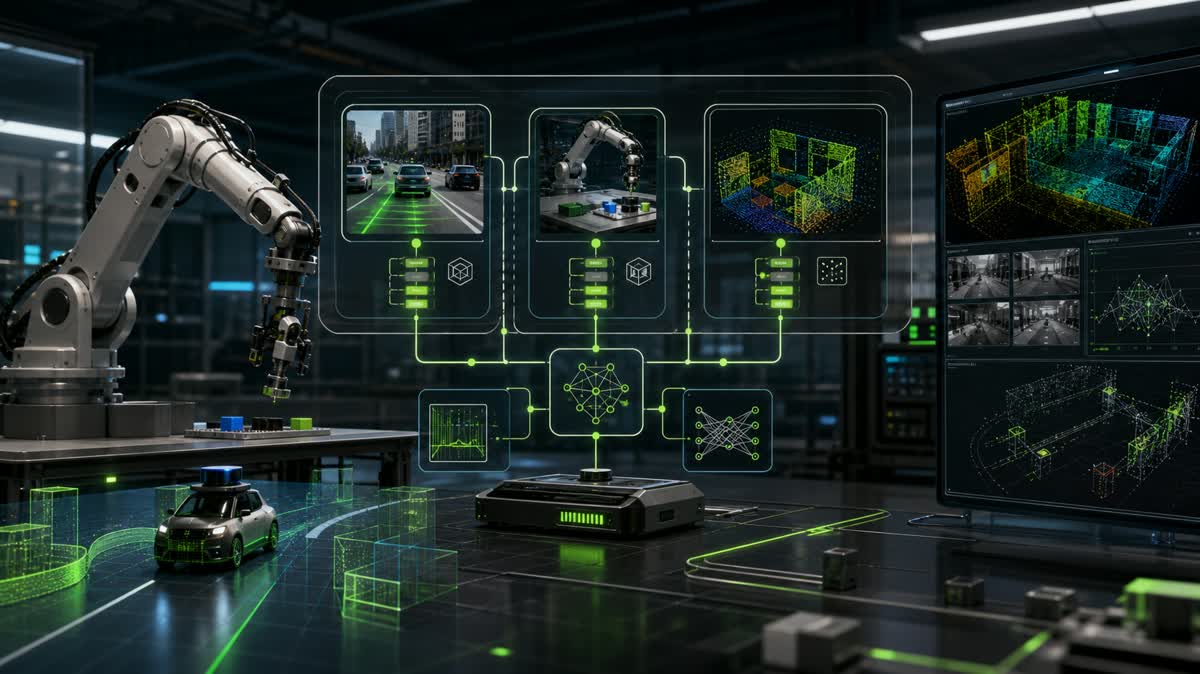
NVIDIA is using CVPR to push physical AI development toward a more agent-driven workflow. The company says new agent skills powered by Cosmos 3 can help researchers automate pieces of the development loop for autonomous vehicles, robotics, and vision AI.
The practical target is not a new robot model by itself. NVIDIA is trying to reduce the manual glue work around physical AI: reconstructing real-world scenes, generating synthetic edge cases, setting up simulations, training policies, and evaluating behavior. Its autonomous-vehicle skills include neural reconstruction workflows that turn fleet-captured data into editable 3D scenes, while AlpaGym connects closed-loop reinforcement learning with high-fidelity simulation.
For robotics, the company is positioning Isaac Sim, Isaac Lab, Omniverse libraries, and GR00T tooling as agent-addressable infrastructure. The announced skills cover scene preparation, simulation setup, navigation workflows, sim-to-real iteration, and policy evaluation. NVIDIA also points to Cosmos-H-Surgical-Simulator for surgical robotics data generation, a sign that the work is aimed beyond driving and warehouse robots.
The GitHub-hosted skill documentation shows how narrow some of these building blocks are. The neural reconstruction skill routes between USDZ rendering, NCore conversion, 3D Gaussian splatting, sensor simulation, and physical-AI datasets rather than presenting a single end-user app.
That matters because physical AI has been bottlenecked less by demos than by repeatable experimentation. Agent skills are a developer-infrastructure story: making simulation, data generation, and evaluation easier to chain together without requiring every research team to rebuild the same workflow by hand.