Meta releases Muse Spark Open for local inference across two Mac Studios
Meta released Muse Spark Open on October 15, making the weights of an 816-billion-parameter multimodal model available for developers to download. The model activates 42 billion parameters and supports a one-million-token context window, with a focus on coding and multi-step agent workflows.
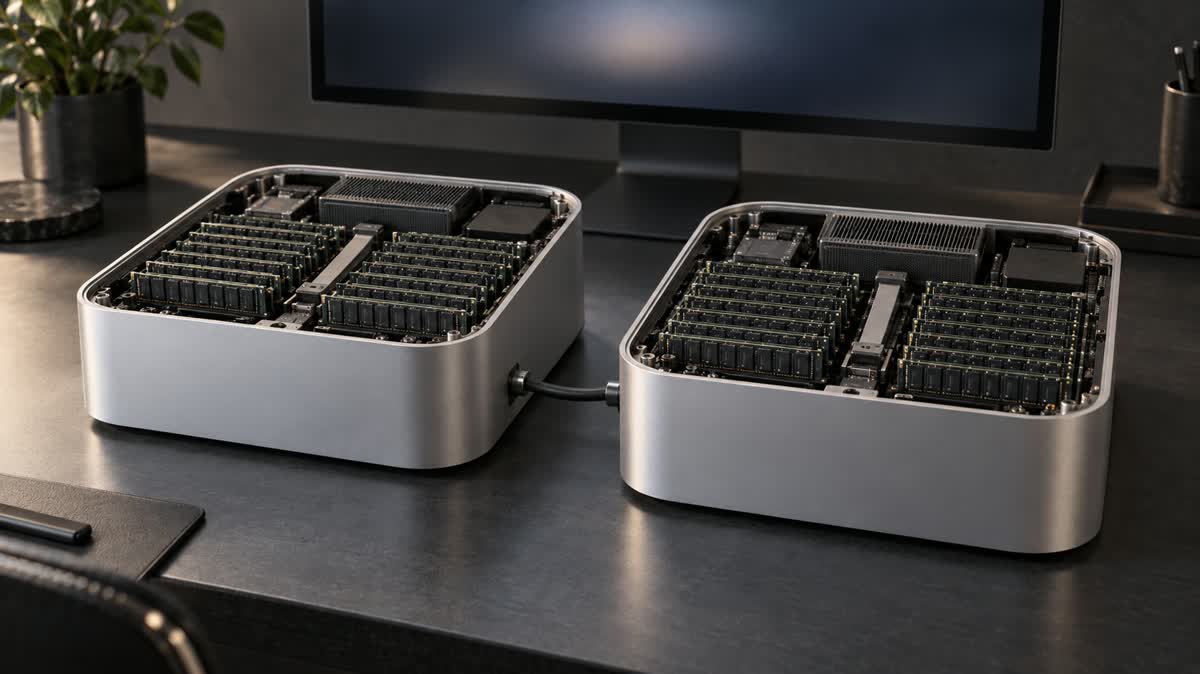
The release adds a local deployment option alongside hosted APIs, but its desktop configuration is far beyond a typical laptop. Meta describes running the model across two M5 Ultra Mac Studios, using Apple's MLX framework and up to 512 GB of unified memory per machine. Together, that provides a terabyte of memory to hold the model.
Local agents, with substantial hardware requirements
Meta says it tested entirely on-device workflows through its Muse Code terminal, including changes to the open-source Ice Cubes Mastodon client and footage review and vertical cropping in DaVinci Resolve. These are company-reported demonstrations, not independent evidence that the model can reliably handle arbitrary desktop tasks.
Developers can also use hosted inference through providers including Baseten, Fireworks AI, Groq, Modal, Nebius, OpenRouter and Together AI. Downloadable weights are offered through Hugging Face and several cloud model catalogs. Meta lists support for inference stacks including vLLM, SGLang, llama.cpp and MLX.
The licensing distinction matters: Muse Spark Open is released under the Muse Model License with limited commercial terms, rather than an unrestricted open-source license. The license requires a separate agreement for model-as-a-service businesses whose aggregate revenue, including affiliates, exceeds $20 million over any consecutive 12-month period.
For teams evaluating local agents, the practical trade-off is greater deployment control against substantial memory requirements and license conditions. The release broadens access to downloadable model weights without making high-end local inference inexpensive or universally accessible.