Allen Telescope Array Uses AI Agents to Control Observations and Process Live Signals
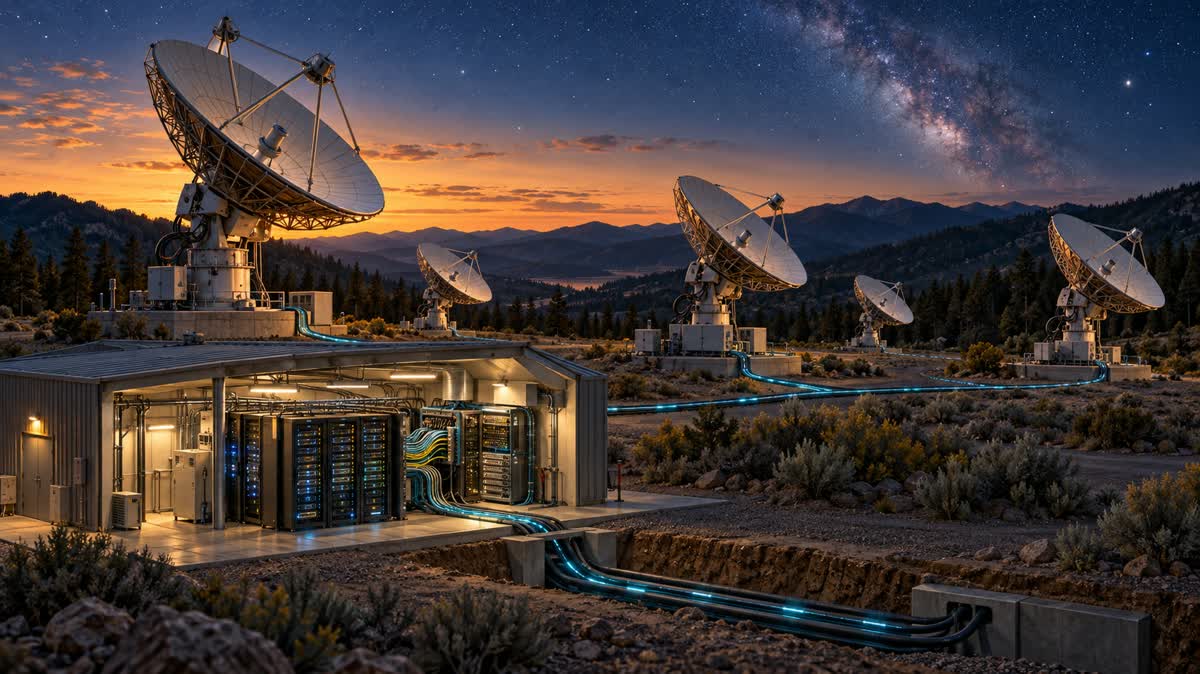
The Allen Telescope Array in Northern California is using AI agents to coordinate observations and process incoming radio signals, according to an October 30 NVIDIA report describing work by Breakthrough Listen and the SETI Institute.
NVIDIA says researchers can use natural-language requests to steer the instrument, calibrate observations, inspect data errors and apply AI models to live streams. The development connects agents to scientific equipment and its processing infrastructure, rather than limiting them to analysis of stored datasets.
How the pipeline works
DAQIRI, NVIDIA's data-acquisition library, moves high-bandwidth sensor streams into GPU memory for processing. CyberEther supplies signal-processing and visualization capabilities, while Nexus orchestrates compute resources and observation pipelines.
The Stelline project's documentation independently identifies those components in its radio astronomy stack and lists the Allen Telescope Array as a deployment target. It also demonstrates live data ingestion, real-time correlation and visualization over a 100-gigabit Ethernet connection.
NVIDIA reports that the broader system can handle 2.4 terabits per second, with inference running on premises beside the instrument. That figure is a vendor-reported system capability, not an independently benchmarked result in the announcement.
A scientific demonstration, not an alien detection
NVIDIA says the pipeline has already detected a pulsar in the Crab Nebula using real-time AI. A pulsar is a rotating stellar remnant; the demonstration is not evidence of extraterrestrial intelligence.
The practical advance is a tighter loop between observation, processing and instrument control. Researchers can potentially adjust a running experiment without first storing its entire output for later analysis. The team is also evaluating open models, including NVIDIA Nemotron, for workloads where local processing and turnaround time matter.